Back to portfolio
Project 04 / 05 · Personal Project 2026

From Hand
to Algorithm

Using an oil skull painting as the foundation, exploring what survives when your own work is handed to a generative algorithm — and what it becomes.

MediumFine Art × AI Product Design
ToolMidjourney V7
Outputs2 Product Concepts
The Concept

Rather than prompting from scratch, I wanted to see what happened if I included my own work in the process.

Having developed a personal passion for both fine art and, more recently, generative image-making, I became curious whether I could find ways in which to combine the two. Rather than prompting from scratch, I wanted to see what would happen if I included a painting of my own in the process - using a skull I'd painted in oil as the foundation, and asking Midjourney to translate its texture, anatomy, and mood into real, tangible objects. Getting to these two final products took many failed attempts, prompt adjustments, and the occasional happy accident.
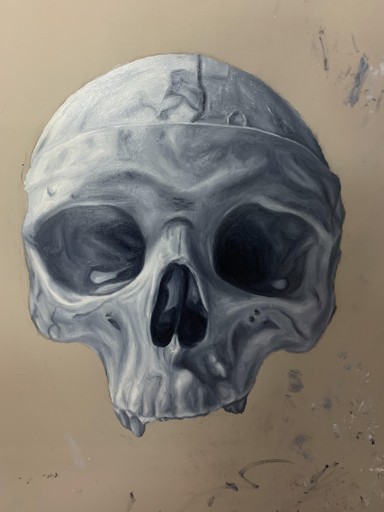
Original skull painting
Skull Study Alina Kuznetsova (me) — Oil on canvas, 2024

Why combine the two mediums?

The idea was that by grounding the AI in a painting I'd actually made, something of its character might carry over: the weight of the brushwork, the texture of the paint surface, the particular anatomy of the skull I'd spent time studying and rendering.

I chose this painting specifically because it felt like a strong visual foundation for product design. The skull form naturally suggests vessel-like objects, and the monochrome palette felt transferable to materials like chrome and ceramic. I wanted to see how much of what I'd put into the painting could survive being handed to an algorithm and translated into something entirely different — but still inspired by it.

I wasn't interested in generating something from nothing. I wanted to use AI as an additional tool — a way to take something I'd already made and explore what else it could become, while keeping my own work at the centre of it.

I had been actively learning Midjourney through taking courses, and this project became a way to test what I'd learned, and to push it somewhere more personal than a standard prompt.
Translated Into Product
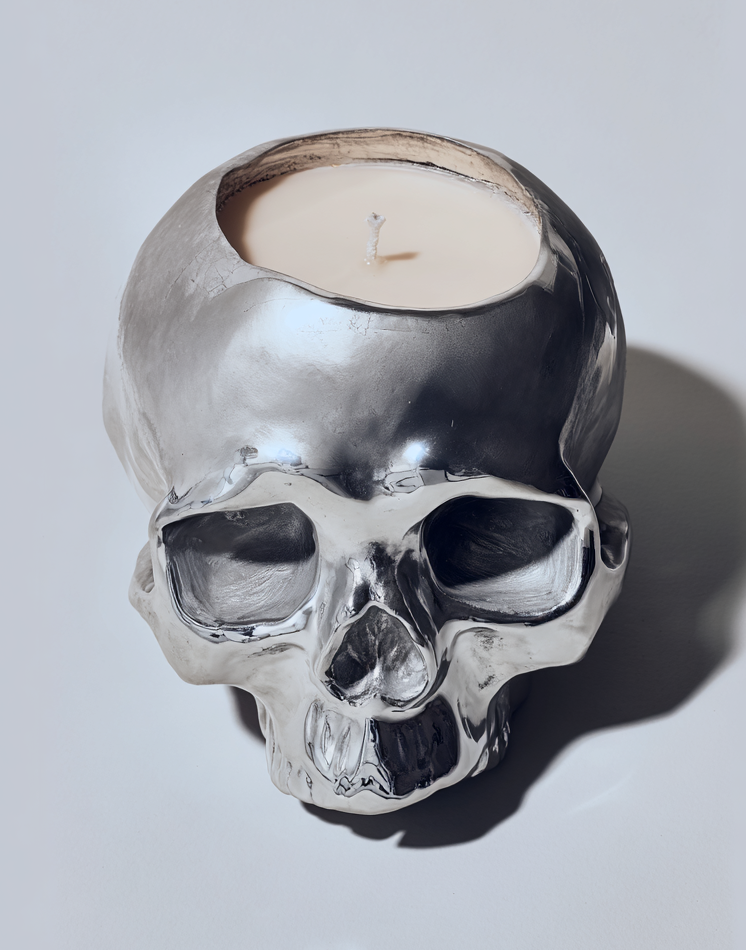
Chrome Skull Candle Holder
View Process
Chrome Skull Candle Holder

The final result maintains the skull's anatomy from the original painting — the cranial dome, deep eye sockets and jaw structure all carry through. The chrome surface picks up a subtle paint-like texture rather than reading as perfectly smooth, echoing the deliberate marks of the brushwork.

Final Prompt
hyperrealistic chrome skull candle holder, top of skull removed with white wax candle inside with wick, slight overhead, front-on angle, professional studio product lighting, plain white background, commercial product photography, shot on 85mm lens --chaos 5 --raw --stylize 50 --iw 0.7
Ceramic Skull Vase
View Process
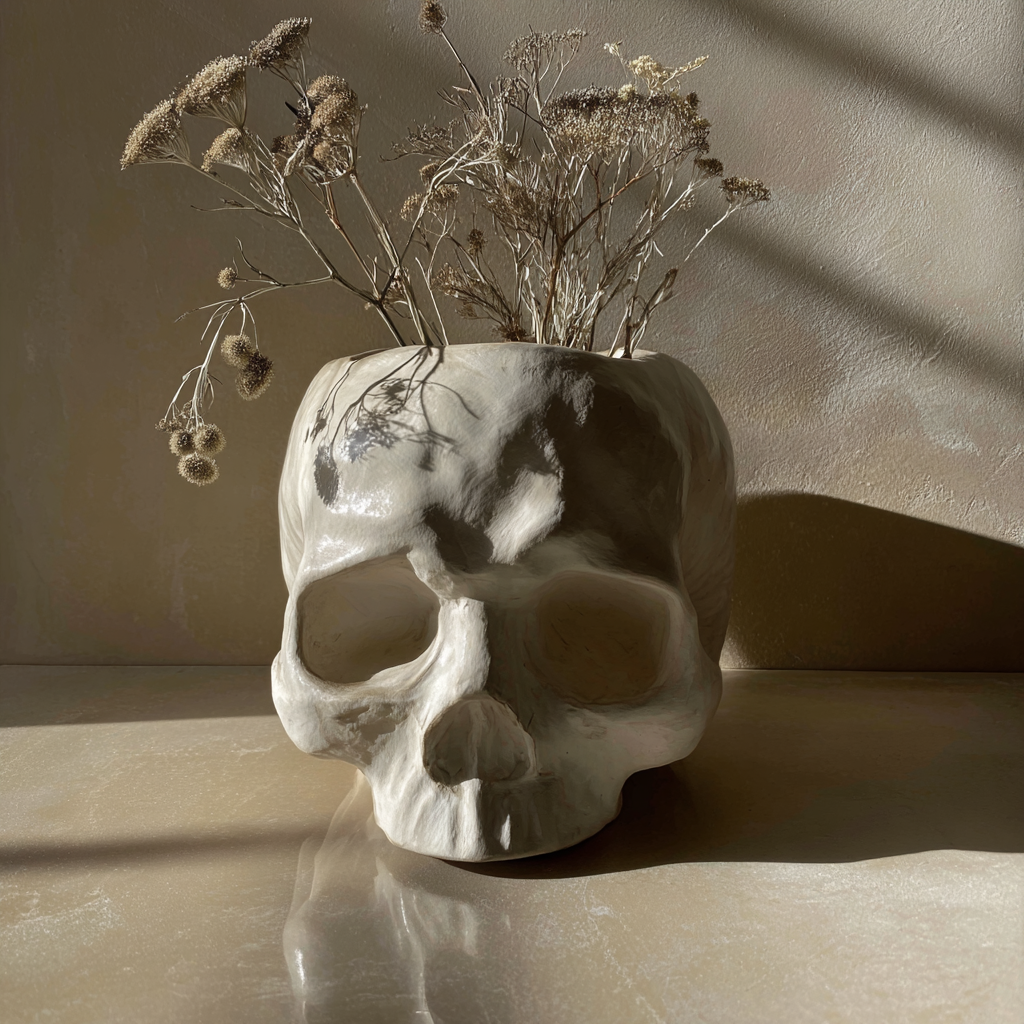
Ceramic Skull Vase

The ceramic form closely follows the skull's anatomy as painted — the proportions, the eye cavities, the organic irregularity of the bone structure. The matte glaze retains a slight roughness that nods to the texture of the original brushwork, rather than a glossy finish.

Final Prompt
ceramic skull vase, dried wildflowers and botanicals emerging from open cranium, dusty rose, ivory, sage, muted neutral tones, warm sandy beige background, dramatic natural side lighting, long soft shadow cast on wall, editorial product photography --raw --sw 50 --iw 0.5
Process

Key Insights

01 - Prompting

Sometimes less is more

Overcomplicating prompts often confused the algorithm, producing unexpected or unwanted results. Simpler, clearer language consistently performed better.

02 - Image weight

Getting the balance right

Getting --iw right was critical. Too high and the output didn't read as a product; too low and the texture and anatomy were lost entirely. Finding the right balance was key to translating my work into a product.

03 - Reference images

A dramatic impact on the result

The style reference image had a dramatic impact on the result. The wrong reference could push the output into completely abstract territory, while the right one brought it much closer to the desired feel.

04 - Experimentation

Patience and a willingness to try

Getting to the final results took many more iterations than documented here. Patience and a willingness to experiment was as important as any prompt technique.

Behind the scenes — iteration process